


- Like PartySafe on Facebook
- Follow PartySafe on Instagram
- For more info, please email partysafe@berkeley.edu
 |
Our House: Risk Management and Harm Reduction Workshops and Consultation
In April 2015, students launched Our House, Our Rules, Our Responsibility. Use our PartySafe Toolkit, workshops, and online resources to create gatherings that are fun and safe. Intervene effectively in emergency and non-emergency situations that arise. Safety and well-being are the top priority. Email partysafe@berkeley.edu for more information.
Fentanyl Test Strips (FTS) and Naloxone Training and Distribution
Our Harm Reduction Expansion Project addresses risks of potential fentanyl contamination.
UC Berkeley students, staff, and faculty can 1) complete this form to pick up a free kit containing 2 doses of Naloxone and 2) pick up Fentanyl Test Strips with instructions - limit of 3 per person - at various times and campus locations.
Student Outreach and Tabling
Our peer-to-peer stations promote harm reduction information and resources at key times and places, including weekly on Sproul Plaza and on key game days and party nights. Fill out this Volunteer Form if you're interested in helping.
Engage and Inform Campus Leadership
PartySafe Peer Advocates participate in relevant campus and community leadership meetings and initiatives as needed to ensure a full range of student experiences and voices is represented. To apply, fill out this Volunteer Form to begin helping.
Do You! Week (Semesterly)
A week-long series of events at UC Berkeley to promote a campus alcohol and other drugs (AOD) culture that supports all who study, live, work, and play in the campus area. Visit our Do You! webpage for more information.
Harm Reduction Counseling and Support
UHS Social Services offers confidential alcohol and other drug-related services supporting harm reduction goals for individuals. No charge to get started, and all registered students can access individual counseling or group services regardless of their insurance plan. A Harm Reduction Group is held Tuesdays and Fridays from 2-3:30 pm. Call for an intake at (510) 642-6074.
Recovery Meetings and Sober Socials
The Collegiate Recovery Program (CRP) holds weekly recovery meetings and monthly sober socials for undergraduate and graduate students. Our monthly sober socials are open to recovery allies, those living substance-free, as well as students in recovery or currently struggling with substance use. Email .
Stay Connected and Get Involved
Like our Facebook page and follow our Instagram page. Fill out this Volunteer Form if you're interested in helping. We’ll follow up within 2-3 business days.
 |
CUSP - Alcohol Poisoning Emergency InterventionIf you notice any one of the CUSP alcohol poisoning signs, don’t let your friends “sleep it off.” Call 911. |
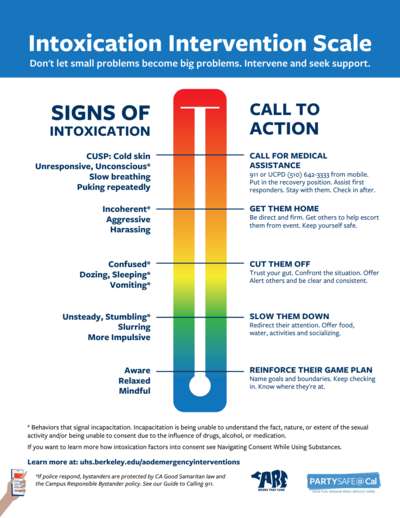 |
Intoxication Intervention ScaleKnow the visible signs of intoxication and learn when and how to intervene. |
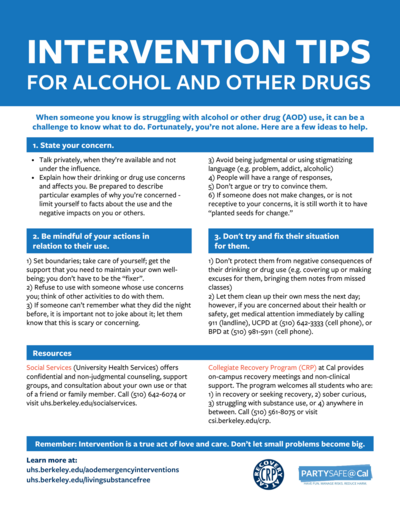 |
AOD Intervention TipsWhen someone you know is struggling with alcohol or other drug (AOD) use, it can be a challenge to know what to do. Fortunately, you’re not alone. Here are a few ideas to help. |
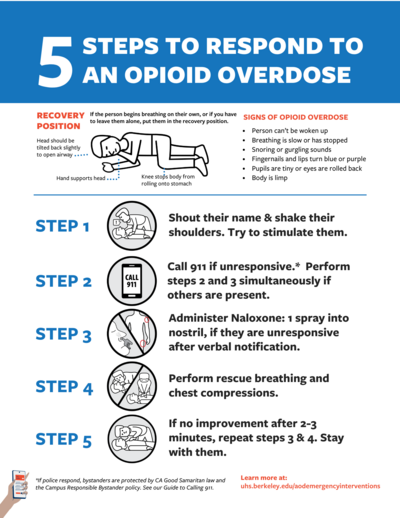 |
5 Steps to Respond to an Opioid OverdoseAn opioid overdose can be life-threatening and requires immediate emergency care. |
 |
Responding to Stimulant OverdosesWhen people overdose on a stimulant, they experience some of the symptoms shared on this flyer. |
 |
Do You - My Experiences, My ChoicesWhatever the reasons, they are yours...own them. When it comes to drinking, always remember to do you! |
 |
City of Berkeley Quiet HoursHave fun while being respectful of your neighbors. Post this to remind you and your housemates of the city-wide quiet hours. |
|
|
Blood Alcohol LevelBlood Alcohol Level (BAL) is the amount of alcohol present in your blood as you drink. It’s calculated by determining how many milligrams of alcohol are present in 100 milliliters of blood. |
|
|
Obtain Free FTS & NarcanAccess to Free Fentanyl Test Strips (FTS) and Narcan (Naloxone) on and off campus. |
|
|
AOD Checking in with YourselfQuestions to ask about your relationship with AOD. |
|
|
Collegiate Recovery ProgramFind your recovery community at UC Berkeley! |
 |
AOD Bystander InterventionIf you see any signs of possible overdose call for medical assistance. You don’t have to be a hero to do the right thing. Make the call! |
 |
Navigating Consent While Using Alcohol & Other SubstancesDetermining whether consent is present or even possible while engaging in sexual activity can be complex when you or your potential partner(s) have been drinking and/or using substances. |
 |
A Guide to Calling 911 for Emergency Medical InterventionWhen calling 911 in response to an overdose, take these steps to promote the dispatch of medical first responders. |
|
|
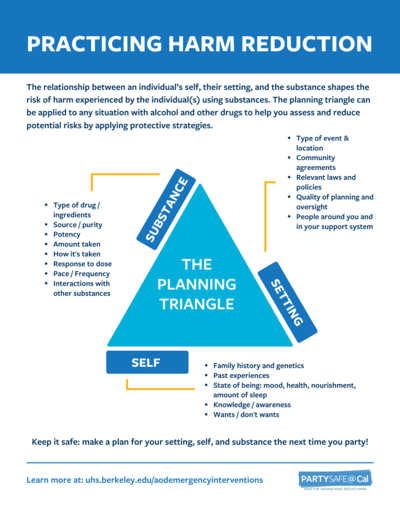
AOD Planning TriangleThe planning triangle can be applied to any situation with alcohol and other drugs to help you assess and reduce potential risks by applying protective strategies. |
 |
Non-Consensual DruggingIf you're concerned that you or someone you know has been given drugs without knowledge or consent, use these campus resources and information to help. |

Emergency
- 911 or (510) 642-3333 (UCPD) for immediate emergencies
- AOD Risks, Signs of Overdose, and Steps to Take
- Non-Consensual Drugging
- UC Berkeley Responsible Bystander Policy